
The Arts of Amsterdam

Art comes in many forms: paintings, sculptures, and, yes, food. Our second day in Holland was dedicated to consuming the visual and culinary arts through the Netherland’s most famous museum and a Michelin guide restaurant that served us the best restaurant meal of our lives.
If you Google “Dutch agriculture,” it becomes immediately obvious that the Netherlands plays a vital role in supplying the world with sustenance. I’m interested in quality farm to table ingredients because my family owns the only Certified Naturally Grown Farm in Hampton Roads. Basically, this means that they practice organic methods and are chemical-free (no pesticides, herbicides, etc…). I loved selling at farmers markets with them, and I believe in the importance of clean products, supporting small, family businesses, shopping locally, and eating seasonally. Leiden hosts a market every Wednesday and Saturday, and it’s a great opportunity to snack, savor, and feel like a local (or an extra in a cozy Hallmark film). We were fortunate our trip lined up with a relaxed Wednesday morning so we could enjoy the centuries-long market tradition.
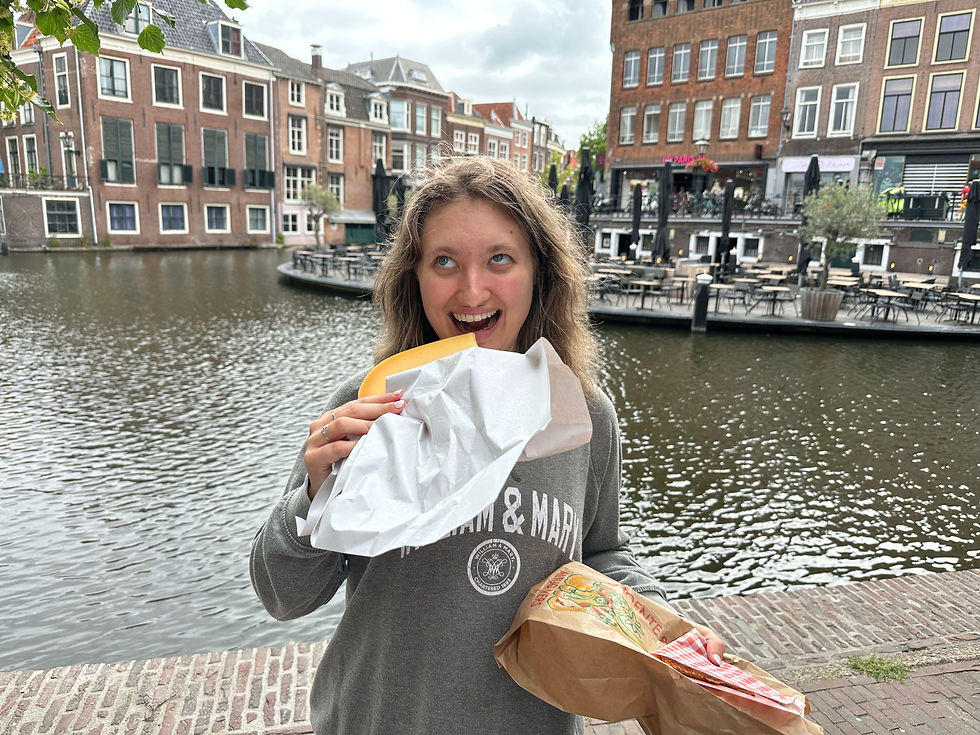
After a coffee in the lobby, we walked to the market to assemble snacks for breakfast. The first stop was for fresh stroopwafel, an indulgently sweet treat that reminds me of Christmas-time and smells like fresh caramel. It consists of two thin, crunchy, waffle-like cookies that are bound together with a syrupy filling, making them the perfect portable breakfast, snack, or dessert. On the trend of sweet, I couldn’t pass up a container of massive strawberries that were unbelievably fresh and juicy. Needing to balance out after those two saccharine purchases, we stopped at a cheese vendor’s booth for a hunk of cheese I nibbled at like a satisfied mouse on our walk to the train station. Our penchant for walking was quite fortunate with all of the eating we’d do on this trip!
The trains from Leiden to other parts of the country are frequent, easy to navigate, and much more comfortable than I would have expected. There is also an abundance of English on menus, signs, and other posted literature, and because the locals were all fluent, it was very easy for us to confidently navigate on our excursions. Tom remembered some Dutch from his time in Leiden eleven years ago, and knowing how to say “hello” and “thank you” will get you further than you think in your travels. Something I enjoyed about the trains is that they were double-deckered. Sitting on the second floor gave us good views, relative quiet, and a sense of novelty. It’s a thirty minute or less commute to the major cities via train, and this made adding Amsterdam and later Delft to our schedules a breeze. If we had more time, we could have also easily visited Utrecht, the Hague, and Gouda, but it gives us more to look forward to for the eventual “next time.”
Once we got to Amsterdam, I was struck by the charm it shared with Leiden while still feeling like a modern city. Its architectural and cultural history were beautifully preserved while still catering to both a posh and pedestrian clientele who are eager to shop, eat, and be entertained. It’s only 2.5 kilometers from the train station to the Rijksmuseum, the national museum of the Netherlands that boasts 800 years of history. The walk was a great opportunity to start getting a feel for the city and took us less than 45 minutes to complete. Whenever possible, I really recommend walking in Europe–it’s the best way to stumble upon beautiful sights, great snacks, interesting shops, and to experience the city as the locals do.
I had already bought our tickets in advance, so once we scanned in, we were off to the races. We started in the basement and worked our way up. While we spent about 5 hours perusing the many, many exhibits, we still didn’t get to everything. However, I wouldn’t say that the museum felt overwhelming. We like to take our time as we read and learn about the exhibits, and it’s nice to know that there’s more to discover next time. Our visit at the end of June meant that there were school tour groups, but given the massive size of the museum and the flow of the groups, it didn’t feel too crowded or uncomfortable. This would differ significantly from Versailles where personal space was at a premium in the height of the French tourist season a few days later. Overall, while the Dutch towns and cities had their crowded moments, they never felt overly congested, crammed, or claustrophobic.
I really enjoyed that the exhibits had Dutch and English explanations, so it was easy for us to learn about the art and history. The explanations even had a sense of humor to them at times, and we appreciated the occasional cheeky cards. While the museum is the home to the Dutch Masters, it didn’t feel stuffy or pretentious and didn’t take itself too seriously. As someone who has very little understanding of art and is very interested in history, I was able to learn a lot and enjoy myself in the process.

The basement held a display of model ships, a weapons display, and a temporary fashion exhibit, checking off 3 of our cultural interests right off the bat. I spent a semester learning about medieval martial arts in college and have gone to a “military through the ages” reenactment event a few times, so it was cool to see the swords up close. We spent the rest of the time mainly enjoying the paintings, and they boast some big names in their collection: Rembrandt, Vermeer, Van Gogh. One of their most famous paintings on display is “The Night Watch,” which takes up a massive wall with its awe-inspiring size and detail. However, it was in the process of restoration during our visit, but we found that it made the viewing experience even more unique. With the assistance of microscopes and years of research, they are taking the old varnish off the painting and letting the public watch the process unfold. While I wanted to see the painting up close, I appreciated that we could “see behind the curtain” and learn a little bit about how such old pieces of art remain so well preserved.

The museum’s closing prompted our exit, but we could have easily spent another hour or two wandering the upper two floors. We had about an hour and a half of time to kill before our dinner reservation at my most highly anticipated spot of the trip, De Silveren Spiegel, but I had another item on our to-do list first: wander the historic streets and window shop. If something caught our eye, we could stop and explore further, and we were lucky to find some real gems on our walk! Near the museum was a historic prints ship that had some beautiful anatomy prints that Tom bought for his office. Not far from that was a chocolate shop, and even though dinner wasn’t far away, we had to sample a few pieces. We passed by Anne Frank’s house and of course saw more canals and historic streets.

De Silveren Spiegel is located inside a beautifully preserved 17th century building that embraces you with its timeless charm and elegant atmosphere. All of the ingredients are seasonal, local, and Dutch, and the reviews I found online were overwhelmingly positive. Plus, it received a coveted nod from the Michelin guide at a price that was fair for the quality of the food.

What amazed us with each course was that we were filled with surprise, admiration, and wonder without feeling overwhelmed, confused, or disconnected from the food. Yves Van Der Hoff is an artist with a delicate touch; he shows creativity and whimsy while letting the ingredients shine and speak for themselves. The balance of flavors was consistent throughout the meal, and while rich courses like lobster, veal, and raspberry could easily become too rich, Van Der Hoff had a careful hand and eye with the menu’s preparation. With 8 courses and amuse bouche to start, there was not a single bite we didn’t enjoy, and we left the dinner wishing we could have it all over again the very next day. The artistry, the poetry of the ingredients on the plate, the commitment to fresh and local sourcing, and the masterful techniques elevated our dinner and will not be easily eclipsed.

Full, but not unpleasantly so, we slowly made our way back to the train station after a slight detour through the Red Light District. The streets and shops were not nearly as salacious as I had imagined, and I distinctly remember commenting to Tom how shockingly tame it all was. In fact, there is even an imposing Gothic church in the center of it all that just happens to be the oldest building in Amsterdam (appropriately named The Old Church). Yes, there were bars where groups were smoking weed, but the pungent stench was limited to these establishments, and it is illegal to smoke outside of these “coffee shop” terraces. Yes, there were those businesses that made the Red Light District so famous, but they were easy enough to avoid, and if you weren’t looking for them, you could miss them. Walking through Guam’s downtown, you’ll find just as many of those businesses with far less legal regulations and protections. There were partygoers, but it didn’t seem any more rowdy than a group of college students going out for the night. I have to say, I was pleasantly surprised.
The next day would find us in the beautiful city of Delft and reuniting with one of Tom’s old friends at a memorable dinner. Plus, we got to sample the most iconic snack of all: fresh herring.


Comments